
Awakening Compassion through the Greeks. Nina Papathanasopoulou writes about the value of teaching classics in the 21st century.
Updated: Mar 11

Seven boys sit upright at their desks reciting the Aeneid, a Latin epic poem written by Virgil between 29 and 19 BCE. A teacher’s voice is heard evaluating each student on his recitation. One of the students, Moritz, makes a mistake and inserts the word enim (‘for’) instead of ille (‘that one’). The teacher pauses giving him another chance. The boy makes a second mistake trying olim (‘already’) this time. The teacher becomes increasingly upset. Another student, Melchior, intervenes suggesting that olim would actually fit the meaning of the Latin text and tries to initiate a discussion on the interpretation of the text. Furious, the teacher repeats that the boy has made an error. He disregards Melchior’s suggestion and adds that “our world has been littered with more than sufficient critical commentary on textual conjecture.”
The scene comes at the opening of Spring Awakening, Frank Wedekind’s 1891 provocative masterpiece, which was rewritten as a Broadway musical in 2006, revived in 2015, and staged twice in recent years by the National Theatre of Greece in 2008-2009 under the direction of Nikos Mastorakis and most recently in a new adaptation in 2022. According to the National Theatre of Greece website “Frank Wedekind’s masterpiece Spring Awakening has remained a provocative work ever since its first appearance. Full of sensitivity, lyricism and tenderness, it embraces adolescent concerns and the need for real contact with parents and teachers, while at the same time recognizing the adult world’s inability to respond to their cry for help.” The play is about teenagers who fail to receive guidance and support from their parents, teachers and society in which they live. Dramatizing the pressure these high school students are subjected to, the play presents them engaging in this aimless and fear-fostering exercise. The students want to embrace life, experience love, and dream about their future, but the adults in their lives prevent them from learning to communicate and to stand up for themselves. You wouldn’t know that the play was written more than a century ago as it seems to capture modern day sentiments about reading Ancient Greek and Latin: a useless endeavor and one more suitable to the elite education of primarily white boys in 19th century Europe.
An essay on the rise of artificial intelligence by Dr. D. Graham Burnett, a Professor of History at Princeton University who specializes in the history of science, published earlier this year in The New Yorker, argues that while AI tools like ChatGPT can transform how we read, write, and access information, they are unable to replace the meaning and satisfaction produced by studying the humanities. Though Burnett points out that AI may soon generate scholarly monographs “at the push of a button” and handle much of the “knowledge production” that once defined academic life, this “factory-style scholarly productivity,” Burnett insists, “was never the essence of the humanities. The real project was always us: the work of understanding, and not the accumulation of facts.” As Burnett pointedly clarifies, the core questions that every human being faces – How should we live? What should we do? How do we face suffering, failure, uncertainty, or death? – cannot be answered by data and data analysis. Indeed, as Burnett also argues, these questions belong to the realm of “being,” not “knowing,” and no machine can replace the experience of our lives and our responses to them.

Paradoxically, then, automatically generated fact-based scholarship underscores the enduring value of the humanities: the study of the humanities guides us in making sense of our lives and of the terrifying yet exhilarating experience of being human. The study of Classics and the ancient world, with its persistent inquiry into human relationships, fate, responsibility, justice, love, and mortality, remains uniquely positioned to cultivate that kind of understanding—an understanding no algorithm can replicate.
Ancient Greek literature, from Homer and Hesiod to lyric poetry, drama, historiography, and philosophy, focuses on familial relationships, the role of the divine, intergenerational conflicts, gender issues, the concept of justice, and the definition of goodness. The Iliad and the Odyssey, the earliest works of Greek literature that we have, strive to define what it is to be human, and explore the limits of human ability and thought. The Homeric heroes challenge their mortal boundaries, and often transgress into the realms of gods or animals. Achilles, for example, initially denies the dying Hector his burial and declares that he would prefer to eat his enemy’s body raw like a beast in nature (Iliad 22.337-354), while Odysseus’ success in killing all 108 of Penelope’s suitors is likened to that of a god (Odyssey 23.62-68). The Homeric poems are also interested in the existence of fate and the role of the divine, and often ask: are humans responsible for everything that happens to them, or is there something beyond us like gods or fate that determines human actions?

Furthermore, the Greeks realized early on that humans are deinoi, unique, terrible and awe-inspiring creatures, capable of lofty and sophisticated thoughts, but also of destructive savagery. Much of Greek tragedy deals with human limits, and centers on humans who exemplify this paradox, like Heracles, Oedipus, Odysseus, Ajax, Creon of Thebes, Medea, Phaedra, Agamemnon, Clytemnestra, Orestes and Electra. Oedipus, for example, is celebrated as a great leader and savior of the Thebans, and yet he turns out to be the most wretched of mortals. Tragedy is also interested in forms of government and definitions of justice and speaks to many issues that concern countries around the world today: how to respond to cruel dictators or administrations that do not have the support of the majority.

As the Greeks created democracy and moved from being ruled by kings to being rulers themselves, they began to ask new questions about themselves. Were they primarily members of a family, or members of a greater community? And when the values and goals of these two entities differed, should they remain loyal to their family, or do what was best for their state? In Aeschylus’ Oresteia, for example, Agamemnon struggles between his role as the leader of the army and that of a father, and chooses to put the well-being of his men over that of his own daughter.
Aren’t these like the mundane and not-so-mundane questions we all wrestle with today? How do we relate to our parents, our children, our teachers, our students, our friends, our partners? Don’t college students often feel at odds with their parents, while striving to understand themselves and their purpose in life? Do you believe in God? And if God exists, is he (or she) the one responsible for bringing justice to the world? Or are we solely responsible for everything that happens to us? Is everyone striving to be good and just? What is our responsibility to ourselves and to the communities in which we live? It is not easy to answer these questions and always act according to your beliefs. The Greeks struggled with such questions too.
It is important to focus on such questions when teaching Classics today, in the 21st century. Classical mythology and Greek drama deal with many issues that are of current interest. In both Europe and the U.S. today, for example, the role of women and immigrants are at the forefront of political discussions. The Greeks were constantly thinking about the role of women, foreigners, and immigrants in their society too. Aeschylus’ Oresteia, Sophocles’ Antigone, and Aristophanes’ Lysistrata all focus on the role of women and their relationship to authority figures, to their husbands, and to fellow women. In the absence of her husband, Clytemnestra chooses a lover for herself and takes over her husband’s rule; Antigone dares to go against the city’s laws and confronts authority even at the cost of her life; Lysistrata suggests that women can and should be involved in politics too.

Euripides’ Medea seems especially relevant in the wake of the #MeToo era. Though a foreigner scorned by her husband, Medea finds the power to speak up for women’s rights and against men’s unjust and abusive treatment of women. Women are “obliged to buy a husband” and “accept him as the master of [their] body (despoten somatos)”, she says (Eur. Medea 232-234). “It is not possible to say no to the things a husband wants” (Eur. Medea 237), Medea continues, probably referring to the fact that a husband had the right to sexual intercourse regardless of his wife’s wishes.
However, according to Medea women were trapped and destined to endure such suffering: to leave one’s husband and return back to your parents’ house was considered “shameful (in Greek aklees, i.e. with no kleos, no reputation)” and humiliating; on the other hand, to live with an abusive man she considers worse than death. Medea explains that the situation is quite different for men: if they are dissatisfied at home, they can easily find relief elsewhere. Given the numerous cases of sexual harassment in recent years––both highly publicized and unpublicized––Medea’s concerns do not seem too different from those of women in the 21st century and confirm men’s long-lasting abuse of power in male-dominant societies.

What’s remarkable, however, is that in the 5th century BCE a male playwright, a male producer, a male sponsor, and male actors decided to put up a performance where men dressed up as women would speak up at the most important festival of the year, in front of a primarily male audience of around 15,000 people and condemn men’s abusive behavior. To study these texts inspires students to be self-critical, but also courageous; to give a voice to the weak and abused; to speak up and not feel ashamed of their experience.
Greek literature can also be insightful in thinking about immigrants and refugees. The Odyssey showcases the Greeks’ insistence on hospitality and respect for strangers, while Herodotus examines the Greeks by encouraging us to look at and compare them to other people who may have completely different traditions and perspectives. Herodotus’ famous phrase nomos basileus “custom is king of all” points to the extraordinary differences in values he saw from culture to culture in the ancient Mediterranean and near East. It also highlights the power of custom and the difficulty we may face in accepting something to which we are not accustomed.
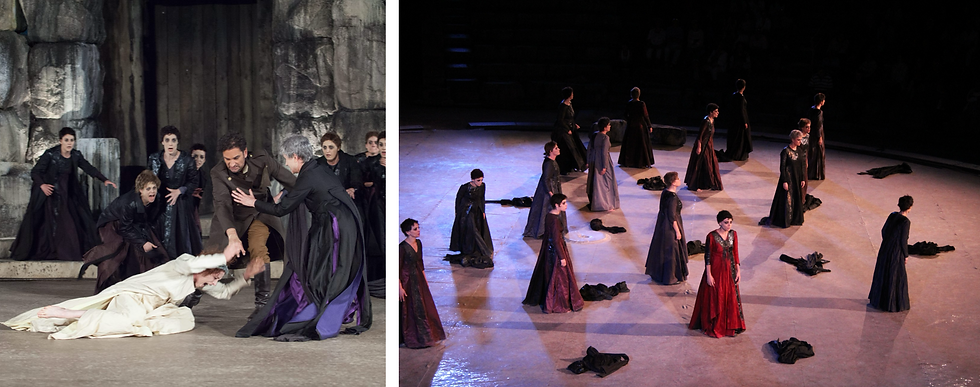
Greek literature also invites us to look at the perspective of our enemies or victims. Euripides’ Trojan Women, for example, focuses on the suffering of the enemy, in this case, the Trojans. At the same time, however, the play emphasizes that whether Greek or Trojan, the Trojan women are primarily human and therefore worthy of our respect and compassion. Indeed, in 2013 a group of Syrian refugees found great comfort in this play and retold their own stories by using the voices of the Trojan women. In Queens of Syria, a documentary about their experience, the Syrian women make it evident that reading and performing Euripides’ play gave them confidence, strength, and hope.
One might ask, however, don’t fields like sociology or political science dedicate themselves to studying such issues? Indeed they do; but to look at these issues through the field of Classics can be particularly rewarding for two reasons.
First, the issues are discussed not in theory, but through intriguing and fascinating stories. The Greeks were exceptionally skilled in storytelling, offering entertainment and excitement to generations after generations, and making their way into numerous literary and artistic creations of different ages.
Second, to study philosophical, social, and political issues through ancient texts and to see the similarity between our concerns today and those of people that lived 2,500 years ago provides us with a sense of continuity and helps us come to terms more with our own humanity and purpose in the world.
The Theater of War project is one of several contemporary projects that use ancient Greek literature to help veterans of war deal with trauma and loss. Bryan Doerries, its artistic director, speaks about the importance of the texts’ age. “Because they are so old,” he says, “they are not threatening to audiences. When a military audience sees one of those ancient plays they don’t feel like we are accusing them of anything. We are asking them to reflect and ask what they can recognize in this. When service members and soldiers of today see their own experiences reflected in an ancient story, it brings immense relief. People discover that they are not alone and most critically not alone across time.”


Dance can serve a similar purpose. The Greek-inspired dances of the revolutionary dancer and choreographer Martha Graham show how ancient stories can speak directly to contemporary audiences. By reimagining figures such as Medea, Jocasta, Clytemnestra, and Phaedra on the dance stage and presenting their stories from a female perspective, Graham turned myth into a dance language for emotions—jealousy, grief, desire, responsibility, violence—and encouraged viewers to perceive the continuity of human struggle across time. Her work reminds us that Greek myth is not dead material to be memorized, but a living tradition that can be reinterpreted across art forms and across generations, helping audiences recognize themselves in stories more than two thousand years old.
The Greeks and their literature are fascinating in and of themselves, but to use them as a teaching tool to understand our life experiences and to elicit sympathy and compassion for human beings across time and across the globe is sorely needed today. For our world to be a better place, we don’t only need more scientists and entrepreneurs—though we do need those; we need people who are more sensitive to their environment and more compassionate toward other human beings. The Greek texts explore the human tendency for competitiveness, violence, and victory, even as they encourage compassion and a consideration for the other’s humanity. And compassion is vital for the well-being of any society.
–––––––––––––––––––––––-

Dr. Nina Papathanasopoulou (BA, University of Athens, PhD Columbia University) is a professor of Classical Studies specializing in Greek theater, mythology and their reception. She has taught at Columbia University and Connecticut College, and currently teaches at College Year in Athens/DIKEMES in Athens and the summer study abroad program of New York University Tisch. Her upcoming book Martha Graham and Greek Myth: The Ancient World in Modern Dance explores Martha Graham’s Greek-themed dances in comparison to the ancient literary texts, vase paintings, sculptures and other ancient material that served as the dancer's inspiration.